
Beyond the PDF
Many businesses see invoices as documents, often finalized as PDFs sent or uploaded manually. While they contain all business info, they're designed for human reading. UAE’s new e-invoicing system changes this, requiring invoices in a structured electronic format for automatic processing, as defined by the country's Ministry of Finance.
PDFs, images, or emails are not recognized as invoices. This shift moves from visual documents to standardized data exchange, centered on PINT-AE, the UAE’s version of the Peppol model. PINT-AE (Peppol International Invoice – United Arab Emirates) is the UAE’s national implementation of the international PINT standard. While PINT provides the common structure for exchanging electronic invoices, PINT-AE introduces the UAE-specific business rules, mandatory data fields, tax requirements, and validation logic needed to comply with the country’s e-invoicing legislation.
Think of it as a common language with a local dialect. Every country that adopts PINT starts with the same international foundation, but each jurisdiction can add its own requirements to reflect local tax legislation and business practices.
PINT-AE ensures invoice data is understood consistently across systems, affecting how finance, tax, IT, and operations teams handle invoicing, reporting, and validation. PINT-AE standardizes invoice data across every system involved in the transaction. This means finance teams must focus on accurate financial data, tax teams on VAT compliance, IT teams on system integration and data mapping, and operations teams on automated invoice processing. Instead of manually interpreting invoices, each department works from the same structured data, reducing errors and enabling end-to-end automation. Understanding PINT-AE is key to preparing for the UAE’s e-invoicing mandate.
Where PINT-AE Fits Into the UAE Mandate
Operational and legislative updates are supported by PINT-AE. Most organizations in the UAE are subject to e-invoicing regulations, irrespective of their VAT status, with few exceptions. As highlighted in the guide for mandatory fields, participants are recognized through their Tax Identification Number (TIN). The pilot began on July 1, 2026. Following the latest amendments, the implementation deadlines are as follows:
- Businesses with AED 50 million+ revenue: Must appoint an Accredited Service Provider by October 30, 2026, and implement by January 1, 2027.
- Smaller businesses: Must connect by March 31, 2027, and implement by July 1, 2027.
- Government entities: Must connect by March 31, 2027, and implement by October 1, 2027.
While these dates specify connection deadlines, PINT-AE defines the data flow requirements.
Business-to-consumer transactions are not included in the initial phases but may be in the future, with some exclusions such as sovereign activities and specific financial services.
What Is PINT-AE?
PINT-AE is the UAE-specific version of the Peppol International Invoice specification, based on the global PINT model created by OpenPeppol.
It adapts the model to reflect UAE’s legal, tax, and business requirements, enabling service providers, businesses, and developers to exchange electronic invoices while remaining compatible with international standards. PINT-AE covers invoices, credit notes, and self-billing, supporting local compliance within the Peppol interoperability framework.
PINT-AE Is a Data Standard, Not an Invoice Template
A common misunderstanding is that PINT-AE is a new invoice layout. It is not a branded template that businesses download and fill out. It does not determine where a company logo appears, which font to use, or how the invoice looks when displayed to a person.
PINT-AE defines the underlying data. Each piece of invoice information is assigned a specific business meaning and a specific place within a structured file. The invoice number is separate from the issue date. The seller’s legal registration number is separate from the seller’s VAT registration number. The buyer’s electronic address is separate from the buyer’s postal address. Taxable amounts, VAT amounts, quantities, prices, allowances, and totals are represented as individual data elements. The structured invoice can still be converted into a human-readable format when someone needs to view it.
However, the compliant invoice exchanged through the system is the structured data file, rather than the visual rendering alone. This distinction matters because two PDFs may display the same information while storing it very differently. A person can usually interpret both. A computer cannot reliably do so without a common structure. PINT-AE creates that structure.
Does Every Business Need to Generate XML?
The UAE standard electronic invoice is based on structured XML, but that does not necessarily mean every business needs to generate XML files on its own. Under the Ministry of Finance’s model, businesses send invoice data to an Accredited Service Provider (ASP) in an agreed format. The ASP then validates the data and, when necessary, converts it into the UAE-compliant PINT-AE XML format before securely exchanging it through the Peppol network. On the receiving side, the buyer’s ASP can deliver the invoice in the format best suited to the buyer’s ERP or accounting system.
This is where choosing the right e-invoicing provider becomes important. Rather than requiring organizations to redesign their ERP to natively produce PINT-AE XML, providers like Storecove can handle the format conversion, validation, routing, and regulatory requirements behind the scenes. Businesses can continue working within their existing systems while ensuring invoices are exchanged in the format required for compliance.
For finance and IT teams, this means the priority is not building XML generation from scratch. Instead, the focus should be on ensuring your ERP captures the required invoice data accurately and completely so it can be transformed into the appropriate structured format. With the right integration, businesses can connect their existing systems to the Peppol network while minimizing disruption to day-to-day operations.
How to Read the PINT-AE Specification
The complete specification contains several connected layers. Understanding those layers makes the documentation much easier to use.
The Semantic Model
The semantic model clarifies required information before mapping it to an XML location by:
- Defining data meanings, including identifiers, names, definitions, and cardinalities.
- Covering key fields like invoice number, currency, purchase order, buyer/seller information, tax details, totals, payment info, and invoice lines.
- Using specific prefixes for identifiers to ensure consistent referencing (e.g., standard terms use 'IBT' or 'IBG', while UAE-specific terms use 'BTAE').
- Remaining technology-neutral.
Code Lists
- Purpose: Replaces free-text descriptions with standardized codes to enable automatic processing.
- Categories: Includes document types, currencies, payment methods, units, email schemes, tax categories, item types, transaction types, and tax-exemption reasons.
- Examples:
- Item Types: Distinguishes between goods, services, and mixed transactions.
- Transaction Types: Identifies special cases such as Free Trade Zone transactions, deemed supplies, margin schemes, continuous supplies, disclosed-agent billing, e-commerce, summary invoices, and exports.
- Benefit: Ensures consistent data values, removing ambiguities like varied descriptions for 'services'.
Business Rules and Schematron Validation
Business rules determine whether a structured XML invoice is compliant with the PINT-AE specification. While an XML file may be technically well-formed, it can still fail validation if it doesn’t meet the UAE’s business requirements.
These rules check that:
- All mandatory fields are present
- Required conditional fields are included when applicable
- Tax calculations and invoice totals are consistent
- Approved code lists (such as VAT categories, document types, and transaction codes) are used correctly
- Required buyer and seller identifiers are valid
Schematron validation automatically tests these business rules before an invoice is accepted. If any requirement is not met, the invoice can be rejected before it reaches the buyer or is reported to the FTA.
Cardinality
Cardinality indicates how often a field or group may appear. A 1..1 cardinality means it must appear exactly once; 0..1 means optional but max once; 1..n means at least one, multiple allowed; 0..n means it may be absent or repeated. This impacts system design. For example, an invoice number with 1..1 must always be produced, while an invoice note with 0..1 may be omitted. An invoice-line group can repeat due to multiple lines. However, optional fields in the base model may become mandatory based on a UAE business rule for certain transaction types.
Syntax Binding
The syntax binding shows where each business term belongs in the XML structure. It connects the semantic model to the UBL elements in the invoice. Developers use it to find the correct XML path, element, attributes, and nesting. The semantic model asks, “What does this mean?” The syntax binding asks, “Where does this go?”
Code Lists
Code lists are critical for automation because they replace inconsistent descriptions with recognized values. One system might describe a transaction as “service,” another as “services,” and another as “professional service.” A common code gives the receiving system a predictable value that can be processed automatically.
What Information Must Be Present?
- Required Fields: The Ministry of Finance requires 51 fields for electronic invoices and 49 for commercial invoices.
- Implementation Focus: Success requires understanding the origin of each data field (e.g., master records, tax classifications) rather than simply adding fields to your system.
- Key Invoice Identifiers: While standard elements like dates, currency, and invoice numbers are required, electronic invoicing also demands specific identifiers like specification IDs and process types to support automation.
- Transaction Type Codes: UAE invoices use an eight-digit binary code to signal specific features (e.g., Free Trade Zone, margin schemes). Accurate classification requires your ERP or tax logic to identify these features before generating the invoice code.
Document Types and Credit Notes
PINT-AE distinguishes document types. In the UAE, a tax invoice is code 380, a tax credit note is 381, out-of-scope commercial invoices are 480, and out-of-scope credit notes are 81.
Companies cannot reverse invoices with negative entries; corrections require credit notes. Credit notes must state the reason, referencing the original invoice, except for certain volume-discount credit notes with their own rules.
This impacts companies using negative invoices or internal adjustments as substitutes for formal credit notes, requiring process redesigns to align with permitted document types.
Seller and Buyer Identifiers
Party identification has shifted from traditional invoicing to requiring precise identifiers. For UAE businesses, the electronic address is based on the TIN, with scheme 0235, forming the participant endpoint via an Accredited Service Provider. TINs, a 10-digit identifier, differ from VAT numbers and are required for Corporate Tax registration or obtained from the FTA.
Invoices often need seller or buyer registration details like license, Emirates ID, passport, or Cabinet Decision, including issuing authority and location. These identifiers are essential for routing invoices to the correct recipient, validating the transaction, and applying the correct tax treatment. A customer record containing only “ABC Trading Dubai” is no longer sufficient. Businesses will need complete and accurate data, including the company’s registered name, TIN, TRN (where applicable), trade license information, address, and Peppol endpoint to ensure invoices can be successfully exchanged and processed.
Understanding the UAE’s Five-Corner Model
The UAE uses a Decentralized Continuous Transaction Control and Exchange (DCTCE) model. In this system, the seller connects to an Accredited Service Provider, which validates and converts invoice data into PINT-AE, then sends it to the buyer’s provider.
The buyer’s provider validates and delivers the invoice. Simultaneously, tax data is reported separately to authorities.
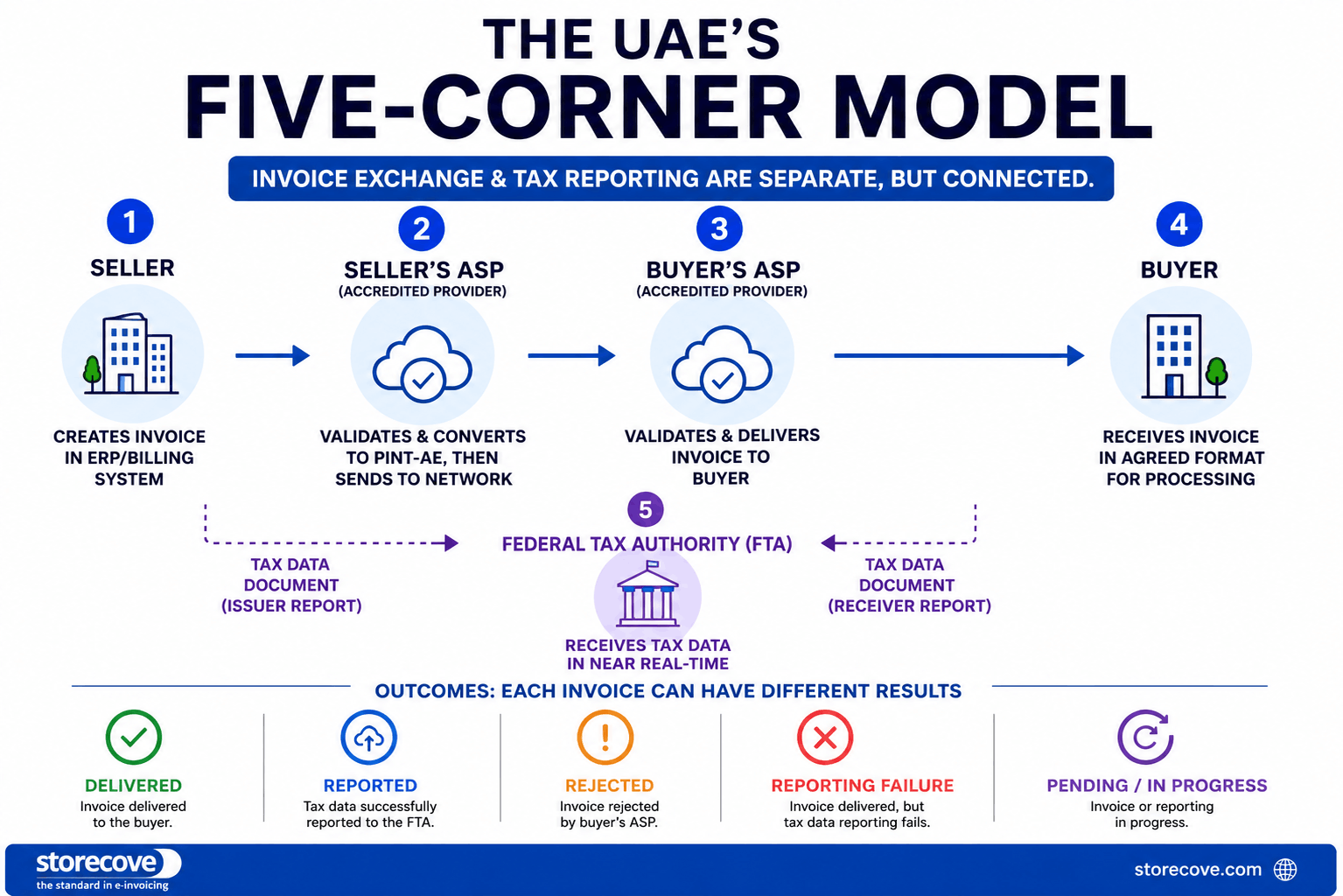
The FTA isn’t just an approval gate; invoice exchange and reporting are separate but connected processes. Businesses must understand that an invoice can be delivered, reported, rejected, or face reporting failure, all as distinct outcomes.
Why Master Data Will Determine Invoice Success
Under manual processes, small data errors can often be corrected by the invoice recipient, such as recognizing a shortened company name or manually searching for a VAT number. They may contact the supplier if a purchase-order number is missing.
Automated validation, however, is stricter: missing endpoint identifiers, invalid TINs, absent tax categories, incorrect country codes, or mathematical inconsistencies can cause validation failures or routing issues.
The problem may arise at invoice transmission, even if the source data was created months or years earlier. Businesses should treat master data as part of their compliance architecture, with clear data ownership: finance for payment terms, tax for VAT treatment, sales for customer records, procurement for suppliers, and IT for system fields. PINT-AE consolidates these responsibilities into the same transaction.
What This Means for ERP Mapping
- Does the ERP capture every required business term?
- Is the captured information in a usable format?
- Can the correct value be selected automatically for each transaction?
The mapping exercise must compare source fields against the complete PINT-AE semantic model, not only against the fields currently printed on the PDF.
For each required field, the project team should determine where the value originates, who owns it, whether it is reliable, what transformation is required, and what should happen when the data is missing. If the business operates multiple ERPs or billing platforms, the same exercise must be performed for each source system. A mapping that works for one legal entity may not work for another.
Outbound and Inbound Readiness Are Different
Many businesses initially focus on issuing electronic invoices. Receiving is equally important.
On the outbound side, the business must create accurate invoice data, send it to the provider, respond to validation failures, monitor reporting statuses, and manage credit notes or corrections.
On the inbound side, the accounts payable system must receive structured invoice information, identify the supplier, validate references, match the invoice to purchase orders or receipts, apply approval rules, and post it to the accounting system.
A company can be ready to send PINT-AE invoices while remaining unprepared to process them automatically.
Without an inbound design, employees may simply convert the structured invoice back into a visual document and reintroduce manual entry. That may maintain continuity, but it loses much of the operational value of structured invoicing. The stronger approach is to use the incoming data directly within accounts payable workflows.
Validation Shouldn’t Be an Afterthought
Under the UAE’s e-invoicing framework, validation occurs during invoice creation, not after. Missing or incorrect data like a Tax Identification Number (TIN) can block an invoice from progressing.
Businesses must identify and fix issues before transmission, making the choice of an Accredited Service Provider crucial. These providers ensure data is properly structured, validated, and ready for exchange before reaching the buyer or Federal Tax Authority.
Storecove validates invoice data before it enters the network, reducing rejections, delays, and manual corrections. Once validated, Storecove securely routes the invoice through the Peppol network to the correct recipient and simultaneously supports the required reporting flow to the Federal Tax Authority (FTA). By managing both validation and routing, businesses can streamline invoice exchange, improve delivery reliability, and adapt more easily as UAE e-invoicing requirements evolve.
Keeping Pace with a Changing Specification
PINT-AE is an evolving standard. As the UAE’s e-invoicing framework develops, expect updates to specs, code lists, validation, and reporting. OpenPeppol has issued multiple UAE spec versions, with more ahead. Internal compliance can be burdensome, affecting ERP mappings and processes.
Working with an Accredited Service Provider like Storecove reduces this load. Instead of tracking updates and managing country-specific integrations, businesses can rely on Storecove for support, maintaining a single connection to their ERP or finance systems. As PINT-AE versions change, companies can operate confidently, knowing their e-invoicing adapts to regulatory updates.
PINT-AE Doesn’t Replace Your ERP. It Makes It Smarter.
A common misconception about the UAE’s mandate is that businesses must replace or overhaul their invoicing processes. They don’t. PINT-AE standardizes invoice data exchange but doesn’t replace existing accounting, procurement, or finance systems. Businesses will still handle VAT, customer and supplier relationships, taxes, and invoicing through their current applications. The difference is how information moves outside the organization.
Accredited Service Providers like Storecove serve as a bridge between internal systems and the UAE’s e-invoicing ecosystem. Instead of direct connections to government requirements, businesses connect once via Storecove while using their existing ERP systems. This reduces disruption for finance, minimizes custom IT integrations, and simplifies compliance.
Preparing for PINT-AE with Storecove
Preparing for PINT-AE begins long before exchanging the first electronic invoice.
Start by understanding your invoice data: which systems generate invoices, where customer and supplier records are kept, which PINT-AE fields are existing or need capturing, and how to identify special transactions like Free Zone or exports.
Storecove helps answer these questions daily.
Storecove helps businesses and software platforms connect to global e-invoicing networks through one API. For the UAE, this means customers can submit structured invoice data to Storecove, after which Storecove supports the required Peppol/PINT-AE flow, including format conversion, validation, delivery, reporting and status feedback where applicable.
The customer or implementation partner remains responsible for preparing the ERP data and mapping it to Storecove’s API, while Storecove provides the e-invoicing infrastructure, sandbox, documentation and network connectivity needed to support compliant exchange.
Instead of treating UAE compliance as a one-off project, this creates a scalable foundation for future mandates across Peppol markets and other country-specific e-invoicing requirements.
Looking Towards The Future
PINT-AE marks a significant step forward in how businesses create, exchange, validate, and report invoice data. While adapting to structured electronic invoicing requires changes to your systems, processes, and master data, it also creates opportunities to improve efficiency, reduce manual work, strengthen data quality, and automate invoice processing. Storecove helps businesses simplify that transition. From ERP integration and data mapping to Peppol connectivity and ongoing regulatory updates, our platform is designed to make e-invoicing compliance easier, so your team can focus on running the business, not managing changing technical requirements.
The UAE’s rollout is already underway, with the voluntary phase now open. Businesses with annual revenue of AED 50 million or more must implement e-invoicing by January 1, 2027, while businesses below that threshold must comply by July 1, 2027. Government entities will follow on October 1, 2027, making now the ideal time to assess your readiness and begin preparing your systems. If you’re evaluating your e-invoicing strategy or preparing for the UAE mandate, our team is here to help.
Whether you need guidance on PINT-AE, Peppol connectivity, ERP integration, or selecting the right implementation approach, Storecove can support you every step of the way.
Read More:
 Lauren Kelly
 Lauren Kelly
 Lauren Kelly

Comments