
The United Kingdom is standing at the threshold of its most consequential tax and business technology transformation since Making Tax Digital. HM Revenue & Customs (HMRC) and HM Treasury confirmed that structured electronic invoicing will become mandatory for all business-to-business (B2B) and business-to-government (B2G) VAT invoices starting April 1, 2029.
To clarify the national technical architecture, HMRC formally confirmed that the international Peppol network will serve as the core interoperability framework underpinning the nationwide mandate. For corporate tax directors, financial systems architects, and enterprise IT leads, the timeline is clear: the era of voluntary digital adoption is closing, and the transition toward standardized Peppol e-invoicing has begun.
The Road to 2029: From Making Tax Digital to Mandatory Peppol E-Invoicing
To appreciate the strategic direction of the UK’s e-invoicing roadmap, it helps to understand how the nation’s digital tax framework has evolved over the past decade. The journey began with Making Tax Digital (MTD) for VAT, a program that successfully mandated digital record-keeping and established direct API linkages between corporate accounting software and HMRC’s submission portals. While MTD modernized periodic VAT return filing, it focused almost exclusively on summary reporting rather than dictating how private trading partners generated, transmitted, or received commercial transaction documents. As a result, British commerce remained heavily reliant on unstructured document formats, including PDF email attachments, paper documents, and fragmented proprietary Electronic Data Interchange (EDI) setups.
The public sector provided the early testing ground for structured electronic messaging. Under its national eProcurement Strategy, the National Health Service pioneered structured data by requiring suppliers to transmit commercial invoices across the Peppol UK domain using the Peppol BIS Billing 3.0 standard. The NHS demonstrated that structured files, formatted to European specifications (EN 16931) and routed via certified Peppol Access Points, could drastically reduce processing errors, eliminate manual data entry, and speed up payment cycles. Building on those operational lessons, the UK government conducted a formal national consultation on e-invoicing, culminating in an official response that confirmed a universal mandate covering all VAT-registered entities starting in April 2029.
Market-Led Interoperability: The Decentralized Peppol 4-Corner Model
The architectural design of the UK’s upcoming mandate sets it apart from many international implementations. Rather than constructing a centralized government clearance portal, such as Poland’s KSeF model, where invoices must pass through a central state server before reaching the buyer, the UK has chosen a decentralized, market-led Peppol 4-Corner model.
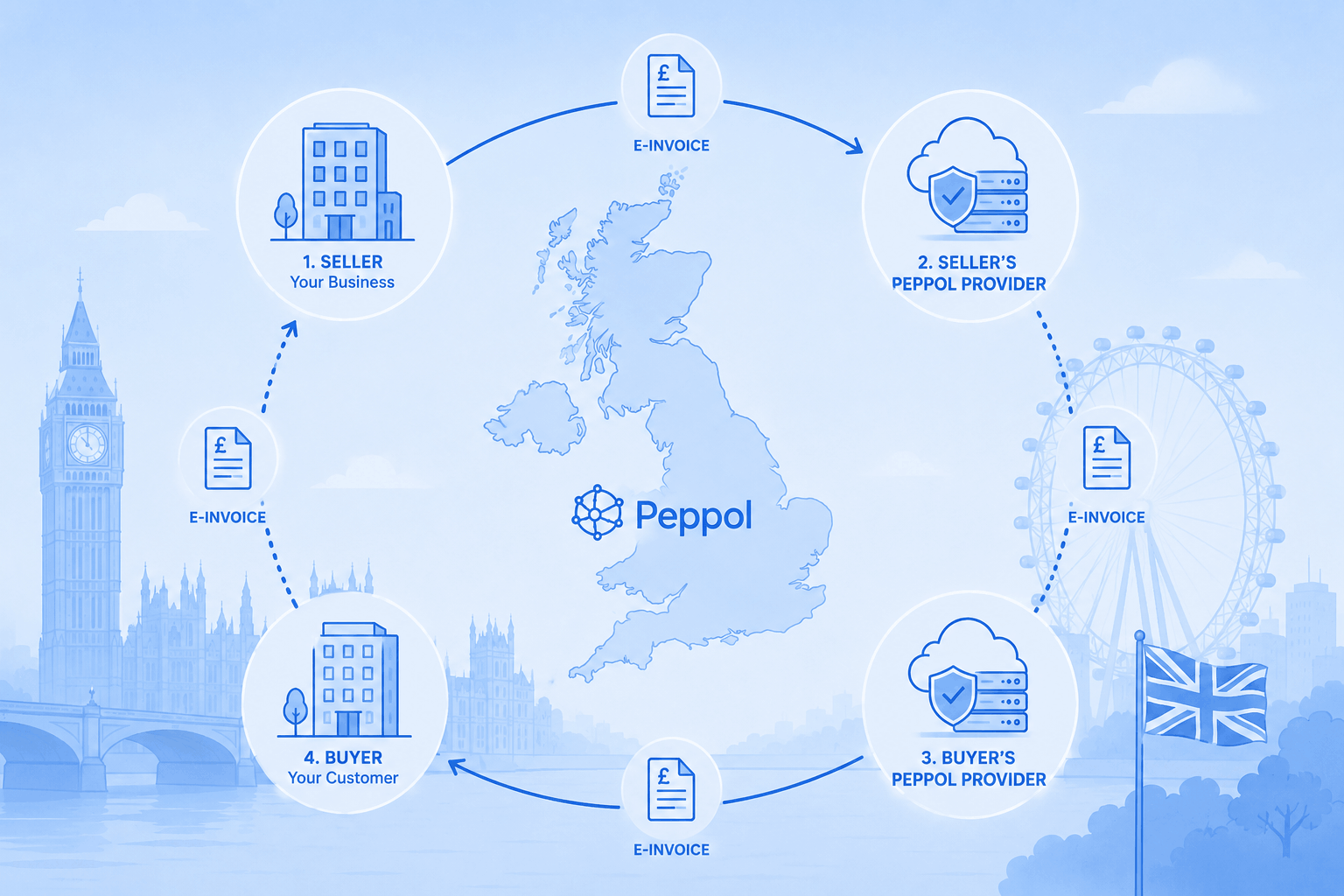
In this four-corner architecture, the transaction begins at Corner 1, where the supplier generates a structured invoice file inside their internal ERP system. Their accredited service provider, operating as the sending Peppol Access Point at Corner 2, validates the document syntax, encrypts the payload, and looks up the recipient's Peppol ID in the global directory. The buyer's accredited service provider, acting as the receiving Peppol Access Point at Corner 3, accepts the secure AS4 message, validates authorization signatures, and decrypts the data payload. Finally, at Corner 4, the buyer ingests the structured Peppol e-invoice directly into their accounts payable software for automated matching and booking.
This decentralized network design provides critical operational benefits for enterprise organizations. Because invoices travel directly between certified network endpoints, transactions avoid central government bottlenecks, reducing transmission latency and eliminating the risk of portal downtime. Furthermore, Peppol's open international standards mean an enterprise only needs to connect to a single accredited Access Point to exchange documents with any trading partner on the network, regardless of the underlying accounting software used. Over time, unstructured PDF attachments will lose their status as legally compliant VAT invoices for domestic trade, shifting the market entirely toward machine-readable XML payloads. HMRC also confirmed that in its initial phase, the 2029 mandate centers strictly on invoice exchange between commercial entities without imposing immediate real-time digital tax reporting or continuous transaction clearance controls.
Strategic Operational Value of Peppol Automation
While regulatory compliance provides the firm deadline for adoption, the business case for migrating to Peppol e-invoicing extends far beyond avoiding tax penalties. For enterprise accounts payable and receivable departments, the transition from unstructured PDFs to native electronic processing yields immediate financial and operational efficiency gains.
Handling traditional PDF invoices requires expensive optical character recognition (OCR) software or manual data entry, both of which introduce human error, misread line items, and delayed approval workflows. Native XML payload exchange over the Peppol network routes line-item transaction data directly into core accounting software, enabling automated purchase order matching, instant error validation, and dramatic reductions in cost-per-invoice metrics.

Furthermore, structured Peppol e-invoicing helps combat the late-payment culture affecting private supply chains. By removing manual validation friction from the intake process, buying organizations can process, approve, and schedule payments much faster. From a risk management perspective, encrypted Peppol AS4 network transmission eliminates common email security risks, including invoice spoofing, altered bank details, and fraudulent billing schemes.
Global Alignment and the European Horizon
The UK’s decision to standardize its national e-invoicing framework on Peppol carries major strategic benefits for cross-border trade. Following Brexit, British exporters navigating international trade face varying compliance standards across global markets.
Across the European Union, the VAT in the Digital Age (ViDA) directive is reshaping cross-border trade by standardizing digital reporting requirements based on the European EN 16931 data standard. Because the UK’s Peppol framework natively aligns with these European structural standards, UK enterprises that configure their ERP systems for domestic Peppol exchange will automatically establish the technical capability needed to trade seamlessly into EU markets.
Additionally, adopting international specifications like Peppol PINT (Peppol International) ensures British enterprise software stacks remain compatible with emerging e-invoicing mandates across Australia, New Zealand, Japan, Singapore, and North America. By aligning national rules with global network standards, the UK prevents technical isolation and lowers the cost of cross-border commerce.
Action Plan: Building the Road to 2029
While April 2029 provides a multi-year runway, upgrading enterprise resource planning infrastructure, refactoring financial workflows, and managing vendor data requirements demands significant lead time. Enterprise technology leads and financial directors should execute a structured three-phase readiness program.

The initial preparation phase requires a thorough workflow audit to map accounts payable and receivable operations and quantify the volume of paper, PDF attachments, custom EDI connections, and digital portal workflows currently in use. Next, organizations must focus on master data governance inside their core ERP systems. In an automated Peppol network, invalid VAT registration numbers, incorrect company identifiers, or malformed address fields trigger instant automated syntax rejections at the Access Point layer, making continuous data validation routines essential. Finally, enterprise leads should select and integrate an accredited Peppol Access Point provider that can execute syntax translations, manage secure protocol handshakes, and dynamically update local tax rule parameters.
How Storecove Simplifies UK and Global Peppol Compliance
Preparing your digital infrastructure for the UK’s 2029 mandate while navigating parallel regulations across global markets requires a resilient, adaptable software layer, and that is where Storecove delivers comprehensive support.
As a certified global Peppol Access Point provider, Storecove offers a single, robust API integration that abstracts away the technical complexities of global compliance. Storecove automatically manages full document syntax translation, Peppol BIS 3.0 and Peppol PINT data formatting, validation checks, and secure transmission across the UK and international messaging networks.
By insulating your internal ERP architecture from changing country-specific mandates, Storecove ensures your business automatically maintains full operational compliance with HMRC directives, NHS procurement rules, and evolving international regulations, all without requiring continuous, costly internal engineering updates.
Read More
 Lauren Kelly
 Lauren Kelly
 Lauren Kelly

Comments