
Under Ministerial Decisions No. 243 and 244 alongside technical directives from the Federal Tax Authority (FTA) and the Ministry of Finance (MoF), the United Arab Emirates is deploying a nationwide digital tax infrastructure. This initiative transitions the country away from paper billing and unstructured PDF email attachments toward a mandatory electronic framework. Central to this legal and operational shift is the adoption of the Decentralized Continuous Transaction Control and Exchange (DCTCE) paradigm, widely known as the UAE 5-Corner Model.
Unlike centralized continuous transaction control regimes that force every enterprise to transmit commercial data through a single government web portal before issuing an invoice, the UAE framework harmonizes decentralized peer-to-peer business document exchange with real-time tax authority oversight. By extending the globally recognized Pan-European Public Procurement Online (Peppol) four-corner architecture into a specialized five-corner network, the UAE establishes a continuous validation loop across suppliers, buyers, accredited service providers, and the central tax node.
1. Paradigm Evolution: From Legacy Post-Audit to Real-Time DCTCE Enforcement
Historically, value-added tax regimes relied on post-audit compliance models. Businesses generated commercial invoices in localized formats, maintained internal transaction ledgers, and periodically submitted summary tax returns to government authorities. Tax officers then conducted delayed, manual audits to verify compliance, a process that created heavy administrative overhead, exposed transactions to billing fraud, and resulted in systemic tax collection gaps.
To solve these vulnerabilities, governments worldwide began introducing Continuous Transaction Control frameworks. Early implementations in other regions often adopted centralized models, where every transaction had to pass through a government-hosted clearinghouse to receive an official digital stamp before delivery to the buyer. While effective for tax collection, centralized clearance frameworks frequently created operational single points of failure, introduced network latency, and forced enterprises to abandon established business-to-business electronic data interchange channels.
The United Arab Emirates selected a hybrid approach by implementing a Decentralized Continuous Transaction Control and Exchange architecture. The DCTCE philosophy recognizes that commercial document exchange and tax reporting should occur simultaneously rather than sequentially. Instead of centralizing the physical transport pipeline, the model delegates technical validation, schema translation, and transport encryption to a competitive ecosystem of regulated Accredited Service Providers (ASPs). In this decentralized setup, commercial invoice exchange occurs directly between accredited access points over secure transport protocols, while the required fiscal tax data is automatically extracted and routed to the Federal Tax Authority in real time. This architecture preserves commercial efficiency and enterprise autonomy while providing the tax authority with complete visibility over economy-wide commercial activity.
2. Node Mechanics and Operational Responsibilities Across the 5 Corners
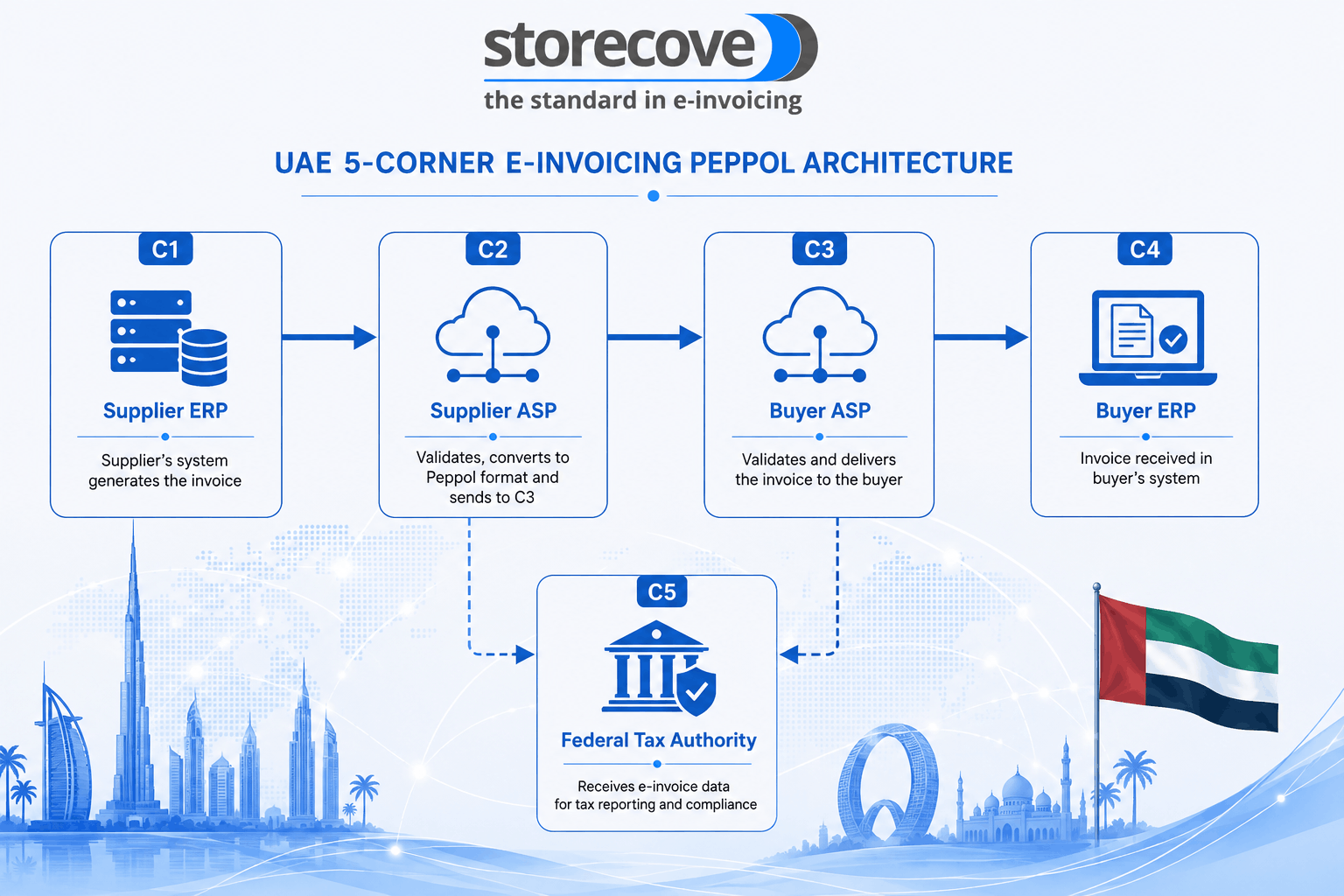
The UAE e-invoicing model establishes a clear division of labor across five distinct technical nodes, designated as Corners 1 through 5. Each corner performs defined operational functions, maintains unique technical interfaces, and enforces localized security boundaries.
Corner 1 (C1 - Supplier ERP)
Corner 1 represents the issuing entity, the seller or service provider, initiating a commercial billing transaction. The supplier’s internal software environment (typically an Enterprise Resource Planning platform, billing engine, or custom accounting software) serves as the source of truth for commercial data. The primary responsibility of Corner 1 is to generate raw transaction data containing all mandatory commercial and tax attributes, such as legal counterparty names, 15-digit Tax Registration Numbers (TRNs), itemized line details, applicable VAT rates, and payment terms. Corner 1 does not need to maintain a direct connection to the Peppol network or the tax authority. Instead, it authenticates securely to its designated Accredited Service Provider at Corner 2 using standardized REST APIs or secure file transfer protocols.
Corner 2 (C2 - Supplier ASP)
Corner 2 is the accredited service provider operating on behalf of the supplier. Serving as the first regulatory gateway, Corner 2 bridges the supplier's internal software with the external e-invoicing network. Corner 2 ingests the raw commercial payload from Corner 1 and transforms it into the canonical XML format mandated by UAE regulations. It executes automated validation engines to verify that the invoice complies with all structural XML schemas, business rules, and mathematical validations. Once validated, Corner 2 applies cryptographic digital signatures using a Hardware Security Module (HSM) to establish data integrity and non-repudiation. Crucially, Corner 2 orchestrates a dual-transmission workflow: it extracts the mandatory fiscal subset and transmits it to the central tax authority node at Corner 5 while concurrently packaging the complete commercial payload for transmission across the secure transport network to the buyer’s service provider at Corner 3.
Corner 3 (C3 - Buyer ASP)
Corner 3 is the accredited service provider operating on behalf of the recipient. Functioning as the entry point for the buyer’s network boundary, Corner 3 receives the encrypted electronic invoice from Corner 2 over secure AS4 transport protocols. Upon receipt, Corner 3 verifies the cryptographic signature of Corner 2, confirms that the sender's digital certificates are valid, and executes secondary syntax checks. It generates an automated technical response known as a Message Level Status (MLS), which is returned to Corner 2 to confirm successful delivery or report structural validation errors. Once verified, Corner 3 converts the standardized XML payload into a schema compatible with the buyer's internal software and delivers the structured document to Corner 4.
Corner 4 (C4 - Buyer ERP)
Corner 4 represents the recipient, the buyer or procurement entity, ingesting the commercial billing document into its financial accounts payable ledger. Corner 4 ingests the structured invoice delivered by Corner 3, enabling automated three-way matching against purchase orders and goods receipt notes. In addition to receiving invoices, Corner 4 generates business-level status responses, such as invoice acceptance, commercial rejection, or payment authorization, which are routed back through Corner 3 and Corner 2 to inform the seller of the document's operational state within the buyer’s accounting workflow.
Corner 5 (C5 - FTA Central Node)
Corner 5 is the central government regulatory node operated by or on behalf of the Federal Tax Authority. Unlike Corners 1 through 4, which manage commercial document exchange, Corner 5 functions as a continuous compliance monitor, data clearinghouse, and central audit log. Corner 5 receives mandatory fiscal reporting data directly from the accredited service providers in the form of a Tax Data Document (TDD). It validates the tax credentials of the counterparties, logs the transaction attributes, performs real-time fraud analytics, and issues official validation tokens or timestamps back to the service providers. By capturing real-time fiscal data without hosting the full commercial payload exchange, Corner 5 maintains complete oversight of national tax liabilities while respecting commercial data privacy.
3. Semantic Foundations and Peppol PINT AE Tax Engine Requirements
The structural foundation of the UAE DCTCE model is the Peppol International Invoice specification customized for the United Arab Emirates, officially designated as PINT AE. PINT AE defines the semantic standards, mandatory data elements, conditional logical rules, and allowed code lists required for structured billing across the nation.
PINT AE relies on Universal Business Language (UBL 2.1) XML as its core syntax, operating under the broader Peppol Business Interoperability Specifications framework. Machine-readable XML allows disparate accounting systems to parse transaction data automatically without manual intervention. The PINT AE data dictionary categorizes billing attributes into three explicit operational tiers:
- Mandatory Elements: Core identifiers that must be present in every transaction, such as unique invoice identifiers (UUIDs), issue timestamps, supply dates, legal names, physical addresses, 15-digit Tax Registration Numbers, transaction currency codes, total line extension amounts, aggregate tax amounts, and grand totals. Missing any mandatory element causes automatic validation failure at Corner 2.
- Conditional Elements: Fields that become mandatory only under specific commercial scenarios, such as foreign currency transactions requiring official Central Bank of the UAE exchange rates alongside converted VAT amounts in Dirhams (AED).
- Optional Elements: Supplementary fields that trading partners may exchange to support internal business operations, such as specialized purchase order line references or project tracking codes.
PINT AE incorporates localized rules to enforce compliance with UAE VAT legislation. Every domestic Business-to-Business and Business-to-Government transaction must contain valid 15-digit Tax Registration Numbers for both the supplier and the recipient. Line items must explicitly reference standardized tax category codes, including Standard Rate (code S, set at 5%), Zero-Rated (code Z, set at 0%), Exempt (code E), or Out of Scope (code O). Furthermore, adjustment documents such as credit notes and debit notes must contain explicit structural references to the original invoice identifier, including the original issue date and a clear legal justification for the billing modification.
4. End-to-End Message Lifecycles and Protocol Orchestration
The movement of an electronic invoice through the UAE 5-Corner Model follows a synchronized, step-by-step sequence designed to ensure data integrity, legal validity, and real-time tax logging.
The transaction begins within the supplier's accounting software at Corner 1. Upon finalizing a commercial billing event, the ERP system extracts the required data attributes and constructs a raw payload (such as JSON or CSV), which is transmitted over an authenticated local API channel to the supplier's accredited service provider at Corner 2.
Upon receiving the raw payload, Corner 2 transforms the data into the mandatory PINT AE XML structure and executes automated Schematron validation engines. These engines verify structural XML compliance, confirm that mandatory fields and mathematical calculations match, and validate that counterparty TRNs conform to statutory formatting standards. If validation fails, Corner 2 aborts the workflow, generates an error log, and returns the document to Corner 1 for correction. If validation succeeds, Corner 2 applies a cryptographic digital signature to the XML payload using an accredited certificate.
Once the PINT AE XML document is signed, Corner 2 executes a concurrent dual-dispatch process:
- Fiscal Reporting Stream (C2 to C5): Corner 2 extracts the mandatory Tax Data Document (TDD), a regulated subset of the invoice containing key header, counterparty, and tax details, and routes it directly to Corner 5. Corner 5 receives the document, executes real-time fiscal validation checks, logs the transaction in the national audit registry, and returns an official confirmation token to Corner 2.
Commercial Transport Stream (C2 to C3): Concurrently, Corner 2 queries the central Service Metadata Locator (SML) and Service Metadata Publisher (SMP) infrastructure to identify the technical address and security certificate of Corner 3. Corner 2 packages the full PINT AE XML payload into an encrypted transport envelope and transmits it to Corner 3 using secure Peppol AS4 messaging protocols.
Corner 3 receives the encrypted envelope, decrypts the payload, and validates the digital signature applied by Corner 2. It runs automated syntax checks to verify that the incoming payload has arrived intact, then constructs an automated Message Level Status (MLS) response. This response is transmitted back to Corner 2 over the network using standardized disposition codes, such as "Code AB" to confirm acceptance or "Code RE" to signal a transport or syntax error. Following an affirmative acknowledgment, Corner 3 transforms the PINT AE XML payload into a format accepted by the buyer’s internal software and delivers the document to Corner 4 for automated accounts payable matching.
5. Security Architecture and Statutory Obligations for ASPs
In the DCTCE architecture, end-user enterprises do not connect directly to the central tax node or the Peppol transport network. Instead, compliance responsibilities are delegated to Accredited Service Providers. To receive and maintain accreditation from the Ministry of Finance and the Federal Tax Authority, service providers must fulfill strict regulatory, operational, and technical criteria.
Transmission between accredited service providers across Corners 2 and 3 relies on the Applicability Statement 4 (AS4) profile customized for Peppol eDelivery networks, operating over Transport Layer Security (TLS 1.3) encryption channels. Data integrity and non-repudiation are maintained through a robust Public Key Infrastructure (PKI). When Corner 2 validates a PINT AE XML invoice, it applies an advanced digital signature directly to the XML structure. Any subsequent alteration to the document content instantly invalidates the mathematical signature hash, causing downstream validation nodes at Corner 3 and Corner 5 to reject the transaction. Cryptographic private keys must be managed using certified Hardware Security Modules (HSMs) meeting FIPS 140-2 Level 3 standards or higher.
To prevent spoofing and ensure secure routing, the network utilizes automated endpoint discovery via Service Metadata Locators (SML) and Service Metadata Publishers (SMP). Before sending an invoice, Corner 2 performs an automated lookup across this infrastructure to verify that the buyer's Tax Registration Number is actively registered and to retrieve Corner 3's public encryption key. Additionally, in compliance with UAE data sovereignty legislation, ASPs must host their core infrastructure and data archives within physical data centers located inside the United Arab Emirates. Transmitted XML payloads, tax data submissions, and cryptographic verification logs must be stored in immutable, write-once-read-many digital archives for statutory retention periods (typically 5 to 15 years).
6. Exception Engineering, Error Recovery, and Adjustments
Given the real-time nature of the DCTCE model, integration architectures must incorporate robust exception handling mechanisms to process validation errors, network dropouts, and invoice rejections without disrupting business operations.
- Pre-Transmission Rejections at Corner 2: If an outbound invoice generated by Corner 1 fails Schematron validation at Corner 2, the document is rejected before it enters the network. Corner 2 generates a detailed error log identifying the specific validation rule that failed. This error log is returned to Corner 1 via API webhooks. The issuing entity corrects the data in its ERP system and re-submits the invoice. Because the document never received a digital signature or entered the transport network, it carries no tax liability and requires no formal credit note to cancel.
- Transport Failures at Corner 3: If an invoice passes Corner 2 validation but fails reception checks at Corner 3 due to a revoked certificate or corrupted XML payload, Corner 3 issues a Message Level Status with rejection code "RE". Corner 2 flags the transaction as failed and alerts Corner 1. Because the transport envelope failed, the invoice is considered legally unissued, requiring Corner 1 to resolve the technical issue with its ASP and retransmit the payload.
- Regulatory Halts at Corner 5: If the Tax Data Document submitted to Corner 5 fails government validation, for example, if one of the counterparties' tax registration numbers has been suspended by the tax authority, Corner 5 issues a fiscal rejection token to Corner 2. A regulatory rejection at Corner 5 halts the transaction across the entire network. Corner 2 immediately revokes the commercial transport envelope, notifies Corner 1, and logs the regulatory rejection.
- Commercial Discrepancies at Corner 4: A commercial rejection occurs after an invoice successfully traverses Corners 2, 3, and 5 and enters the buyer's ERP at Corner 4. If the buyer identifies a commercial discrepancy (such as an incorrect unit price or inaccurate quantity), the buyer cannot simply delete the electronic invoice. Because the document has been cryptographically signed and logged at Corner 5, it exists as a legally binding tax document. To resolve a commercial rejection, the seller must issue a formal PINT AE Credit Note or Debit Note through the identical 5-corner workflow to adjust the statutory tax liability recorded in the national ledger.
7. Enterprise Readiness Strategy and Implementation Blueprint
For enterprise organizations operating within the United Arab Emirates, preparing for the mandatory rollout of the DCTCE 5-Corner Model requires a structured, multi-phase transformation strategy:
- Master Data Governance: Conduct a thorough audit of customer, vendor, and product master databases across all corporate entities, including Free Zone subsidiaries. Teams must extract and validate 15-digit Tax Registration Numbers for all active domestic counterparties, reformat physical addresses into structured data fields, and map product catalogs directly to official PINT AE tax category codes.
- Decoupled API Middleware Strategy: Enterprise IT teams should avoid modifying core ERP database tables to generate PINT AE XML files directly, as custom coding inside legacy financial systems creates technical debt and complicates future software upgrades. Instead, organizations should configure their ERP systems to output standard data payloads (such as JSON or CSV files) and deploy a specialized middleware layer to route data to an Accredited Service Provider's API.
- Strategic ASP Onboarding: Select a qualified Accredited Service Provider based on technical maturity, infrastructure redundancy, security certifications, and global network connectivity. Confirm that the service provider operates a certified Peppol Access Point, evaluate the maturity of its RESTful APIs, and ensure guaranteed network availability with fast processing response times.
- Asynchronous Exception Handling and Testing: Configure accounts receivable workflows to process asynchronous MLS status responses automatically. Participate in voluntary pilot programs and sandbox testing environments to test complex commercial edge cases—including multi-currency transactions, partial credit notes, and simulated network exceptions—well ahead of mandatory enforcement dates.
Transitioning to UAE 5-Corner Compliance: How Storecove Simplifies the Journey
Navigating the complexities of the UAE DCTCE 5-Corner Model doesn't have to mean overhauling your entire IT infrastructure or managing multiple regional middleware platforms. As a certified global Peppol Access Point provider, Storecove bridges the gap between your existing ERP and the Federal Tax Authority. Through a single, lightweight RESTful API connection, Storecove automatically converts raw billing data into fully compliant UAE PINT AE XML schemas, handles real-time Schematron validation, and manages the dual-routing workflow to both your trading partners and the central tax node, complete with statutory digital archiving. Whether you need to prepare your Accounts Payable ledger for reception or automate outbound billing ahead of mandatory ASP deadlines, Storecove delivers a seamless, scalable, and future-proof gateway to compliance in the UAE and across 30+ global e-invoicing frameworks.
Read More
 Lauren Kelly
 Lauren Kelly
 Lauren Kelly

Comments