
While European tax authorities make global headlines with sweeping government mandates and strict continuous transaction controls, the United States is quietly executing its own digital invoicing transformation. American businesses are not waiting on an act of Congress or an IRS decree to modernize their supply chain finance. Instead, a powerful shift driven by enterprise buyers, financial institutions, and industry consortiums is ushering in a new era of standardized electronic document exchange.
At the center of this movement is the Digital Business Networks Alliance (DBNA). The DBNA is not a software vendor or an e-invoicing service provider; rather, it is the non-profit oversight organization and governing body tasked with building North America's open exchange network. Modeled directly on the international success of the Peppol network, the DBNA framework introduces a standardized, secure, and interoperable digital delivery highway across the American market.
For enterprise financial directors, supply chain leads, and corporate technology executives, understanding how the DBNA adapts Peppol-style messaging is critical. The pressure to abandon paper documents and email attachments is no longer coming from government regulators, it is coming directly from major trading partners.
Why the U.S. Is Replacing Legacy EDI and Email PDFs
To understand the momentum behind Peppol-aligned networks in the U.S., it helps to examine the historical friction within American business-to-business payments. For decades, enterprise financial supply chains in North America have relied on two primary invoicing mechanisms: legacy Electronic Data Interchange (EDI) systems and unstructured PDF documents sent via email.
While EDI established early electronic data connections, it remains notoriously rigid, expensive, and complex to configure. Setting up traditional EDI requires custom point-to-point technical mapping between individual trading partners. This model creates isolated digital silos where large enterprises can only transact electronically with suppliers willing to absorb the high cost of custom software integration.

On the other end of the spectrum sits the PDF invoice. While emailing a PDF appears digital on the surface, it is fundamentally unstructured data. Accounts Payable departments must rely on expensive Optical Character Recognition software or manual keying to parse invoice details into their core accounting engines. OCR tools regularly misread line items, struggle with varying layout formats, and introduce costly processing exceptions that slow down approval workflows and delay payment cycles.
Industry research highlights that processing a manual PDF or paper invoice in the United States costs companies anywhere between $12 and $20 per document. Automated processing across a standardized, open exchange network drops that expense to less than $2 per invoice, delivering instant operational savings directly to corporate bottom lines.
What Is the DBNA? Bringing Peppol Architecture to North America
To solve North America’s fragmented e-invoicing ecosystem, the Business Payments Coalition, supported by the Federal Reserve, launched the initiative that led to the creation of the Digital Business Networks Alliance. The DBNA was established as an independent, non-profit governing body to define and manage the technical rules, security standards, and operational policies for a national open exchange framework.
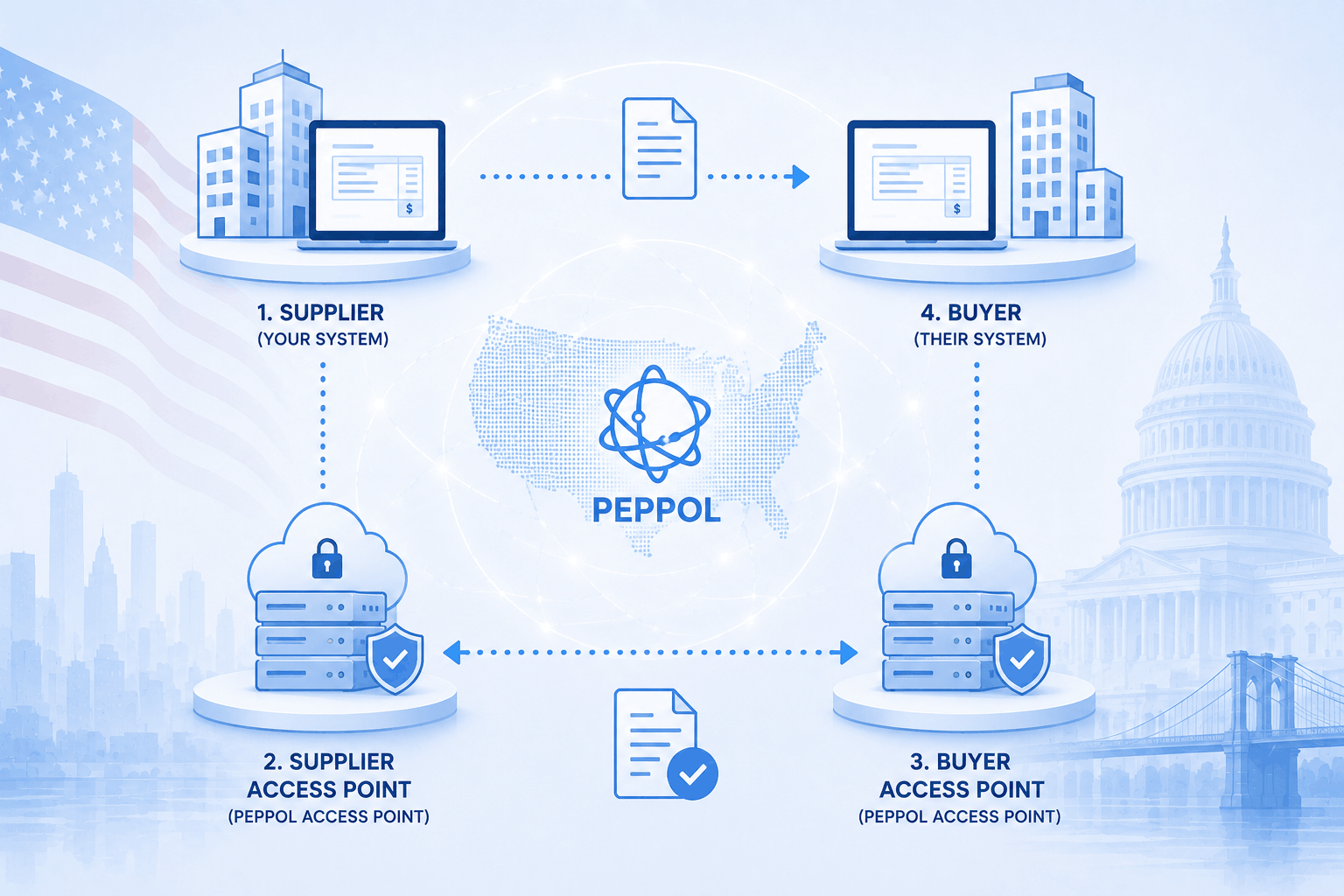
The underlying framework relies on the proven Peppol 4-Corner messaging model. In this four-corner architecture, the transaction begins at Corner 1, where the supplier generates a structured invoice payload inside their internal Enterprise Resource Planning (ERP) or accounting system. At Corner 2, the supplier’s accredited Access Point provider ingests the internal data, translates it into the standardized document format using international OASIS Universal Business Language (UBL 2.3) specifications , and performs syntax validation. The Access Point executes a real-time directory lookup to locate the recipient’s unique network identifier. The sending Access Point then transmits the encrypted payload over secure Peppol-standard AS4 protocols to Corner 3, the buyer’s certified Access Point provider, where authorization signatures are validated, and the payload is decrypted. Finally, at Corner 4, the buyer’s Access Point delivers the structured XML document directly into the buyer’s accounts payable or ledger engine for automated purchase order matching, workflow approval, and booking.
The defining breakthrough of adapting Peppol architecture for the DBNA is network interoperability. Under the old EDI model, a business had to build separate point-to-point connections for every customer or vendor. Under a Peppol-style open network model, an organization connects just once to a certified Access Point provider and gains instant, secure access to exchange electronic invoices with any other entity registered on the network.
Market-Driven Mandates: How Enterprise Buyers Are Forcing Change
Because the United States lacks a federal e-invoicing mandate, the DBNA network's acceleration is driven by market forces often described as private-sector mandates. Enterprise buyers across retail, healthcare, energy, and manufacturing are recognizing that manual Accounts Payable friction is a massive operational drain. Fortune 500 corporations and large buying groups are increasingly establishing vendor requirements that mandate submitting structured electronic invoices over open exchange networks built on Peppol standards.
For suppliers, connecting to an open network is no longer just an IT upgrade; it is a fundamental requirement to maintain vendor standing with major corporate accounts. Suppliers that adopt structured e-invoicing gain significant competitive advantages, including faster approval cycles, reduced payment friction, and dramatically lower administrative overhead.
Furthermore, structured data exchange provides a powerful defense against corporate payment fraud. Email-based PDF invoices are notoriously vulnerable to business email compromise (BEC) schemes, where bad actors intercept email threads and alter bank routing details. Because Peppol and DBNA transactions move over encrypted network channels with authenticated participant identities, the risk of altered payment instructions is virtually eliminated.
Global Interoperability: Bridging US Trade with Peppol Networks Worldwide
While the DBNA was built specifically to address the unique payment mechanics and business requirements of the North American market, it was engineered from day one to maintain international technical alignment. Because the DBNA framework utilizes core Peppol specifications, including OASIS UBL file formats, AS4 secure messaging protocols, and four-corner network governance, it shares direct architectural DNA with Europe's Peppol network and international specifications like Peppol PINT (Peppol International).
This architectural alignment carries massive benefits for multinational corporations headquartered in the United States. As European Union member states roll out mandatory digital reporting under the VAT in the Digital Age (ViDA) directive, American enterprises must ensure their financial systems can issue and ingest compliant structured Peppol payloads internationally.
Connecting to a certified Peppol Access Point provider that operates across both the DBNA and global Peppol networks allows an enterprise to maintain a single technical integration for global document exchange. A US company can seamlessly transmit invoices to domestic buyers over the DBNA while routing compliant international e-invoices across Peppol networks in Europe, Asia-Pacific, and Latin America without managing separate software engines for each jurisdiction.
Action Plan: Preparing Corporate Infrastructure for Peppol & DBNA Networks
While market adoption of Peppol-aligned networks expands across North America, enterprise financial and technology leads should execute a proactive readiness assessment to future-proof their billing systems.
The initial preparation phase requires an internal accounts payable and receivable workflow audit to map document processing volumes. Organizations must quantify how many invoices are currently handled via paper, PDF email attachments, custom EDI setups, or specialized vendor portals to calculate the concrete operational savings of network consolidation. Next, enterprise leads must prioritize master data governance inside their core ERP systems. In an automated four-corner network, inaccurate client identification codes, invalid tax registration numbers, or corrupted address fields trigger immediate syntax validation errors at the Access Point layer, making clean master data essential for automated routing. Finally, organizations should select and integrate a certified Peppol Access Point provider.
Partnering with an accredited service provider ensures your internal systems can execute seamless document syntax translation, dynamic Peppol directory lookups, and secure AS4 protocol transmission out of the box.
How Storecove Connects Enterprise Systems to Peppol & DBNA Frameworks
Navigating the rise of the DBNA network in North America alongside international Peppol mandates requires a resilient, adaptable technical setup, and Storecove delivers complete connectivity.
As an accredited global Peppol Access Point provider and certified DBNA Access Point, Storecove delivers a single, unified API integration that bridges your core Enterprise Resource Planning (ERP) software directly to North American and global exchange networks. Storecove automatically manages full document syntax translation, Peppol BIS and UBL 2.3 formatting, Peppol ID directory validation, and secure AS4 protocol routing.
By insulating your internal technology stack from changing network specifications and regional compliance updates, Storecove enables your enterprise to meet customer mandates in North America, satisfy international Peppol tax mandates abroad, and automate financial operations, all through one powerful, future-proof integration.
Read More
 Lauren Kelly
 Lauren Kelly
 Lauren Kelly

Comments