
For multinational businesses, one of the greatest challenges of electronic invoicing is not necessarily complying with an individual country's requirements. It is finding a way to manage those requirements without creating an entirely different invoicing process for every market they operate in. As governments continue introducing national e-invoicing mandates, enterprise finance and IT teams are increasingly responsible for connecting systems that were not originally designed to work together.
Poland's KSeF mandate is a clear example of this challenge. While many international businesses have invested in Peppol to standardize invoice exchange across their operations, Poland's National e-Invoicing System, known as KSeF, follows a different technical approach. Instead of relying on the decentralized exchange model used by Peppol, KSeF requires covered invoices to be processed through a centralized government platform using Poland's national FA(3) XML schema.
For organizations already operating through Peppol BIS Billing 3.0, this creates an important question. Should businesses redesign their existing ERP systems to accommodate Poland's requirements, or can they connect KSeF to the infrastructure they already have?
The answer lies in understanding how Peppol and KSeF can work alongside one another, with an integration layer managing the differences between their formats, technical requirements, and delivery processes.
Why Peppol and KSeF Present Different Challenges
Peppol has become an important part of international e-invoicing because it gives businesses a standardized way to exchange electronic documents across different systems and trading partners. Through certified Peppol Access Points, organizations can send and receive structured invoices using specifications such as Peppol BIS Billing 3.0, which is based on the European EN 16931 standard.
For multinational organizations, this consistency is particularly valuable. A company operating across several European markets can use the same general invoice structure and exchange infrastructure rather than building individual connections for every customer, supplier, or country.
Poland's KSeF framework introduces a different set of requirements. The national system operates through a centralized clearance model, where invoices within the scope of the mandate must be submitted in the prescribed FA(3) XML format. Once an invoice is successfully processed, KSeF assigns it a unique identification number, which becomes an important part of the invoice's official record.
Although both systems work with structured electronic invoice data, they are not interchangeable. An invoice created using Peppol BIS Billing 3.0 cannot simply be sent through KSeF without ensuring that it meets Poland's specific schema and business requirements. Likewise, exchanging an invoice through the Peppol network does not replace a required KSeF submission.
This distinction creates a challenge for businesses that have already standardized their international invoicing operations around Peppol. Their existing infrastructure may work efficiently across several markets, but Poland introduces additional requirements for data mapping, validation, authentication, and government connectivity.
For a business using a single ERP, these differences may be manageable through a dedicated integration. For a multinational organization operating several billing systems and legal entities, however, the complexity can increase considerably.
The Problem with Building Country-Specific Invoicing Systems
Consider a multinational business using SAP for its European headquarters, Microsoft Dynamics 365 for regional operations, and another billing application for a smaller subsidiary. The organization may already have standardized much of its international invoicing around Peppol, allowing different business units to exchange structured invoices through a common network.
When Poland's KSeF requirements take effect, every system needs a way to generate the required FA(3) data, connect to the government platform, and manage the responses it returns. These capabilities could be developed separately within each ERP environment, but that approach can create considerable technical debt.
Every additional integration requires development, testing, monitoring, and ongoing maintenance. When Poland updates its technical specifications or introduces changes to its API, those adjustments may need to be implemented across several systems. Finance teams can also find themselves managing different invoice statuses, error messages, and processing procedures depending on which application generated the transaction.
Over time, this creates exactly the kind of fragmented infrastructure that many businesses adopted Peppol to avoid. Rather than embedding every country's requirements directly in the ERP, businesses can take a more flexible approach by separating their core invoice generation process from the country-specific rules that govern how invoices are submitted and exchanged.
Connecting Peppol and KSeF Through a Shared Integration Layer
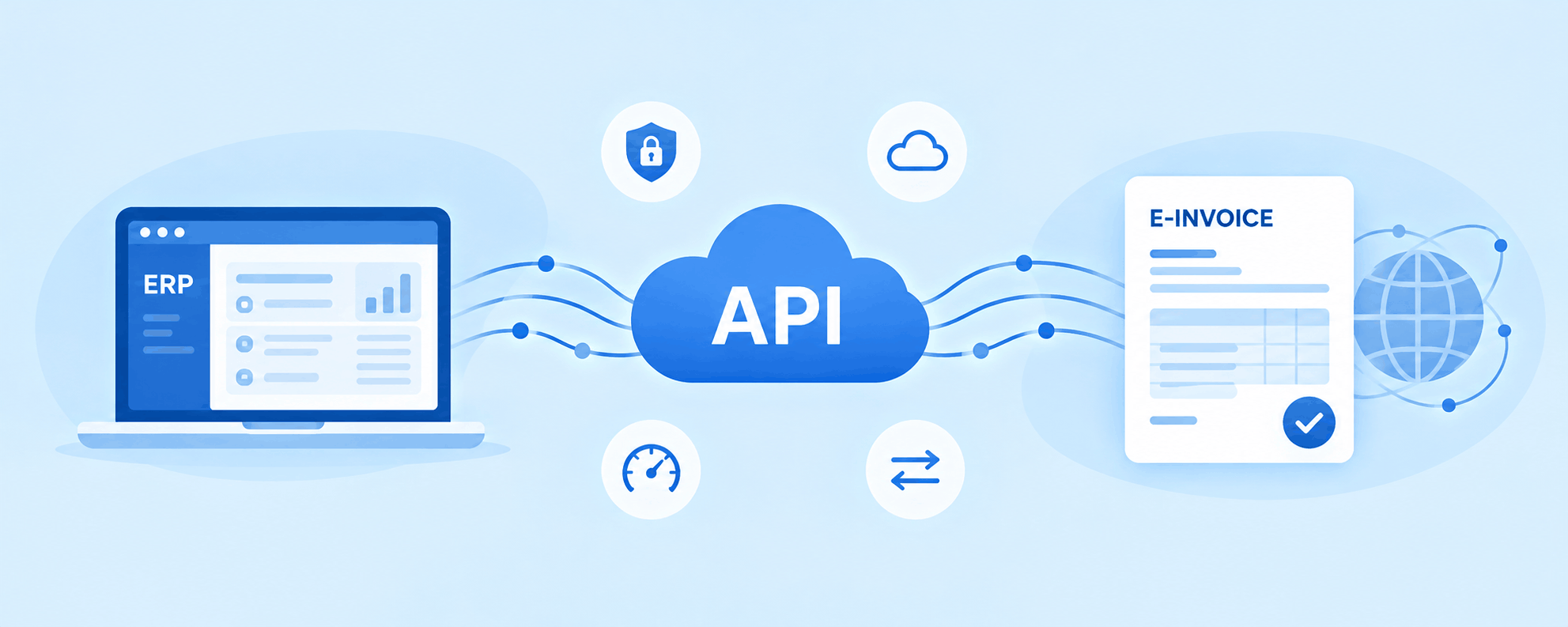
A hybrid Peppol and KSeF architecture allows businesses to retain a standardized invoice output while using an integration provider to manage the requirements of the destination country. Instead of asking the ERP to generate a different invoice structure for every market, the organization can continue producing structured data in a familiar format, such as Peppol BIS Billing 3.0 UBL.
When that invoice needs to be submitted to KSeF, the integration layer translates the relevant information into Poland's FA(3) XML structure. This involves more than converting one XML format into another, because the provider must also account for country-specific tax information, required invoice fields, and differences between the underlying data models.
For example, a Peppol invoice may contain the information needed for international exchange but still lack a particular field required under Poland's national schema. In that situation, the integration must identify the missing information and obtain it from the ERP or another authorized data source before the invoice can be submitted.
Once the document has been prepared and validated, the integration communicates with KSeF through its API. The government platform processes the submission and, when accepted, assigns the invoice its official KSeF identification number. The integration must then capture the appropriate acknowledgments and processing results so that the originating ERP can accurately reflect the invoice's status.
For covered domestic Polish transactions, the invoice is made available through KSeF according to the applicable rules. When the business also needs to provide invoice information to a foreign buyer, the integration can support an appropriate delivery channel, including Peppol where the recipient participates in the network.
The important distinction is that KSeF submission and Peppol delivery serve different purposes. The integration coordinates them without treating one as a substitute for the other. This approach allows multinational businesses to maintain a more consistent invoicing architecture while accommodating Poland's local requirements. Rather than redesigning the entire billing process, they can concentrate the country-specific technical work within a shared integration layer.
Bringing Incoming KSeF Invoices into Existing Peppol Workflows
The same principle applies to accounts payable, where Poland's centralized system introduces a different challenge for businesses accustomed to receiving invoices through Peppol.
An organization using Peppol for international supplier invoices may already have automated processes that receive structured documents and transfer the relevant information into its ERP. These workflows can support invoice matching, approvals, and financial reporting without requiring employees to manually reenter invoice data. Invoices received through KSeF, however, are accessed through the Polish government platform. Without an integration, businesses may need to establish a separate process for retrieving and handling invoices issued to their Polish entities.
A provider with the appropriate KSeF capabilities can retrieve incoming invoices through the government API and convert the FA(3) information into a standardized structure that the organization's accounts payable system can process. Where Peppol BIS Billing 3.0 is used internally, this may involve mapping the relevant invoice information into UBL so that Polish invoices can enter workflows similar to those already used for other markets.
The conversion still requires careful handling. Some information included in FA(3) may not have a direct equivalent in the standard Peppol invoice structure, meaning businesses need a way to preserve the original document, maintain its KSeF identification number, and retain any additional information necessary for compliance or reconciliation. The objective is not simply to make every invoice look the same. It is to reduce operational differences wherever possible while preserving the information each country's invoicing framework requires.
For finance teams handling thousands of supplier invoices, consistency can significantly improve the efficiency of transactions moving through the accounts payable process.
What Businesses Need to Consider Beyond Format Conversion
Although mapping Peppol invoice data to FA(3) is an important part of connecting the two systems, it is only one component of a reliable integration. Businesses also need to consider how their invoicing processes will operate when government systems are unavailable, authentication credentials expire, or submitted invoices are rejected.
Poland's framework includes specific offline and contingency procedures for situations in which invoices cannot be processed through the normal online workflow. Depending on the circumstances, these procedures require invoice issuance, verification codes, and subsequent submission to KSeF within the applicable legal deadlines.
An enterprise-ready integration should support the relevant procedures and keep invoices visible until they have been successfully processed. It should also account for interrupted API connections, delayed responses, and cases where a transaction was received but the originating system did not get immediate confirmation. Without proper reconciliation, automatically resubmitting an invoice after a timeout could create new problems instead of resolving the original interruption.
Authentication is another important consideration. KSeF has its own authorization framework, including access tokens and digital certificates used for specified functions. Businesses processing invoices automatically need to ensure that credentials are securely managed, permissions are appropriate, and authentication failures do not leave billing transactions unprocessed without warning.
Invoice validation also warrants attention. Even a document that meets Peppol BIS Billing 3.0 requirements may need additional information or adjustments to comply with Poland's FA(3) rules. Identifying these differences before submission can help businesses avoid unnecessary rejections and reduce the manual investigation required of finance and IT teams. These operational details are particularly important for multinational organizations, where integrations may need to support several ERP systems, multiple Polish legal entities, and high invoice volumes at the same time. A shared architecture is valuable not only for converting documents but also for managing exceptions consistently.
Why Peppol Matters Beyond Poland's KSeF Mandate
Poland is one example of a much broader challenge facing international businesses. Across Europe, governments are introducing different approaches to electronic invoicing, digital reporting, and tax compliance. Some rely on centralized government platforms, while others support decentralized exchange networks or combinations of the two.
For multinational organizations, building a separate invoicing infrastructure for each new requirement is unlikely to be sustainable over the long term. Even when invoice data is similar, differences in technical formats, authentication procedures, reporting requirements, and government connectivity can create substantial work for enterprise IT teams.
Peppol provides an important foundation by enabling businesses to standardize much of their electronic invoice exchange. Combined with an API-based integration layer that supports additional national requirements, it helps organizations maintain greater consistency across their core systems while adapting external connections to different markets. This approach also matters as businesses prepare for future European developments, including the EU's VAT in the Digital Age initiative, commonly known as ViDA. A Peppol connection alone does not ensure compliance with future digital reporting obligations, but a standardized invoice data structure and flexible integration architecture can make later changes easier to manage.
The long-term benefit is not eliminating every country-specific requirement. It is creating an environment in which those requirements can be supported without repeatedly redesigning the systems responsible for generating and processing invoices.
Simplifying Global Peppol Integration with Storecove
For businesses operating internationally, maintaining a consistent invoicing process while responding to local regulatory requirements is becoming increasingly important. As mandates evolve, organizations need a way to connect their existing ERP environments to different networks and national platforms without creating unnecessary complexity.
Storecove's API-based e-invoicing solutions are designed to help businesses connect their financial systems to supported electronic invoicing networks and services through a single integration. This approach can reduce the need for separate technical connections across multiple markets while allowing organizations to maintain greater consistency in how invoice data is exchanged.
For businesses evaluating how to connect Peppol and KSeF, the key is ensuring that their chosen integration provider supports the specific capabilities required for Poland. These include FA(3) mapping, KSeF API connectivity, authentication, incoming invoice retrieval, validation, and exception handling. Each capability should be assessed against the organization's actual invoicing processes and the provider's currently supported functionality.
The broader opportunity is to establish an invoicing infrastructure that can accommodate national differences without allowing those differences to dictate the design of every internal financial system. Poland's KSeF mandate illustrates why that approach matters. Businesses that already use Peppol do not necessarily need to abandon their existing standards or build an entirely separate invoicing architecture for the Polish market. With the appropriate integration, they can connect their standardized invoice processes to KSeF while maintaining a more consistent foundation for international operations.
As electronic invoicing continues to expand across Europe, this ability to connect local requirements with global infrastructure will become increasingly valuable.
Read More
 Lauren Kelly

 Lauren Kelly
 Lauren Kelly


Comments