
Peppol is the world’s most popular e-invoicing network. It is used in 40+ countries, with many regions requiring its adoption.
Peppol (Pan-European Public Procurement OnLine) is a secure and efficient way for businesses to electronically exchange documents like e-invoices, order responses, and more.
However, there are multiple core formats in use. Are you familiar with both?
In this article, we’ll go over the basics of the Peppol network, an overview of the two most used Peppol formats, and how Storecove can support a successful Peppol implementation.
Let’s get started.
What is Peppol?
Peppol is an open exchange network created to facilitate the efficient and secure transmission of electronic business documents. It was launched in 2012 by the OpenPeppol organization and remains a leading framework for e-invoice exchange. Peppol is a globally-compatible network, but has the most use in Europe and Asia.
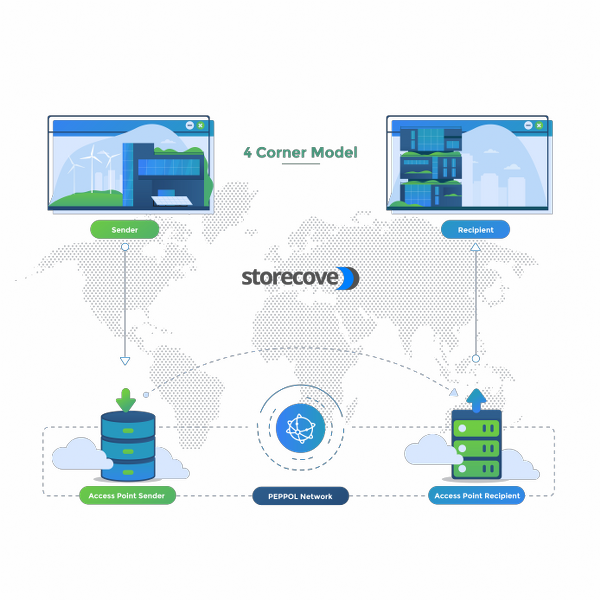
Peppol works by connecting buyers and sellers through certified Peppol Access Points. The most common framework used is the 4-corner model depicted above, where businesses directly transmit documents between their respective access points.
Another common system is the 5-corner model, where the sender’s access point will submit the document to a country’s tax authority before sending it to the receiver’s access point. It functions similarly to the 4-corner model, just with the added step of government validation.
Documents are delivered securely and quickly in both situations. The network works efficiently, transmitting invoices and other forms in near real-time while issuing status updates as files move through the process. Documents sent through the Peppol network are kept encrypted.
The 4- and 5-corner models allow for transparent transactions that are processed much faster compared to manual systems. When using Peppol, you never have to worry about where your documents are or who has access to them: Transactions are always smooth, safe, and reliable.
Read more: Download our free Peppol Whitepaper
Overview of the Most Popular Peppol Formats
As widespread as Peppol is, it makes sense for the network to have multiple formats in use. Different formats are popular in different regions, and the network has plans to merge some in the near future to simplify its e-invoicing flows. In this article, we’ll discuss the two core Peppol formats: Peppol BIS 3.0 and the Peppol International Invoice Model (PINT).
Peppol BIS 3.0
Peppol BIS 3.0 is the latest iteration of the Peppol Business Interoperability Specification format. It is typically used in the EU and is fully compliant with the European e-invoicing standard (EN 16931).
Peppol BIS was originally created in 2012, with the latest version having launched in May 2025. The next BIS update, Peppol BIS 4.0, is currently in the works. It will likely be released in early 2026, although the exact date has not yet been finalized.
These documents are typically sent as UBL files. However, XML files can also be sent through Peppol BIS as CII e-invoices. CII files are less common, but used for hybrid formats like Factur-X and ZUGFeRD.
Read more: Download our free Peppol in Belgium Whitepaper
Peppol International Invoice Model
The Peppol International Invoice Model (known as PINT) makes international Peppol transactions possible.
PINT is similar to Peppol BIS and functions as an extension to support worldwide use of Peppol. It is mostly used in the APAC region by countries such as Japan, Australia, New Zealand, Singapore, and Malaysia. PINT was launched in 2023 as part of OpenPeppol’s efforts to expand international interoperability of the network.
There is some variability in how PINT is used in different countries. For example, businesses in Singapore connect to Peppol through the country’s InvoiceNow platform, while Malaysian businesses use MyInvois. PINT uses UBL documents in all regions.
No information is available on who will be the next to adopt PINT, but more countries will likely follow suit in the near future based on its current popularity and success in the APAC region.
The Future of Peppol
Peppol is constantly growing and evolving. OpenPeppol has announced major upcoming changes to formatting requirements and the network’s function.
A major upcoming change will occur with the release of Peppol BIS 4.0. The update will merge the Peppol BIS and PINT formats, standardizing document compliance requirements across borders. Peppol BIS 4.0 will make it easier to conduct international transactions by increasing interoperability.
The release date of Peppol BIS 4.0 has not yet been announced, but it is expected to launch in early 2026.
Another important development to stay aware of is the creation of the new Enhanced B2B (eB2B) framework.
The Global Exchange Network Association (GENA) has begun implementation of some elements of the eB2B model. EB2B is a Peppol-compatible framework that aims to improve interoperability between service providers, leading to a smoother experience for businesses using e-invoicing. It has an international focus and is compatible with many international mandates, including the EU’s VAT in the Digital Age (ViDA) requirement. Adoption of eB2B is voluntary.
More changes are sure to be announced as Peppol continues to grow. International e-invoicing requirements are constantly shifting, as are business needs.
Read more: Enhanced B2B and the New Peppol Standards: A Guide

How Storecove Can Support Peppol Implementation
Whether you’re connecting to Peppol for the first time or trying to connect to the U.S.’s DBNAlliance network, Storecove is here to help.
As a certified Peppol Access Point, we are prepared to help your business connect to the worldwide open exchange network. Our software will also allow you to send and receive e-invoices through the DBNAlliance at no extra cost. Our global API makes connecting easy: just connect to our software once, and you’ll instantly be able to send and receive e-invoices across the world.
When you send e-invoices with our API, we take care of formatting, validation, and delivery. Our software can easily fit into your organization’s current invoicing flow, allowing you to integrate quickly and meet regulatory requirements without complex onboarding. All you need to do is create an invoice. We take care of the rest, including compliance.
We update our API to account for any change in e-invoicing regulations or standards to help your company stay compliant. Keeping up with new mandates on your own is time-consuming and difficult, but our automatic updates make global invoicing seamless.
The Peppol and DBNAlliance networks are constantly expanding, with new members joining daily and many mandates planned for the next few years. Get ahead of compliance issues by connecting to our API now and keeping your document standards up to date.
Read more: Choosing the Right Peppol Reseller or Partner for Your E-invoicing Needs
Get Started
Wondering whether our e-invoicing solution is a fit for your company? Request a free test account to gain access to a sandbox environment for 30 days. You’ll be able to experiment in a sandbox environment, giving you the chance to explore our intuitive interface and experience the benefits firsthand.
To learn more about Peppol or our e-invoicing solution, book a demo with our team. Feel free to contact us with any questions. We’re here to help.
Read also:

Comments